Pages

Showing posts with label Collaboration. Show all posts

Friday, 14 February 2014

KNITRONICA

Sunday 23rd Feb at Big Hands Manchester , 1pm – 7pm


An interesting event coming up – a live experiment in a Manchester music venue working with knitting and sound, where I will be exploring the parallels between machine knitting and the Tenori-on. The event has been organised by Sam Meech who I am thrilled to be working alongside.


Sam has already explored a lot through knitting which you can see more of here. We will also be joined by knitter Iris Cooper. The event is part of the Whitworth Art Gallery Pub Crawl – a series of arts events in unusual spaces across Manchester.


It will be a textiles experiment, working with live music, sampled sound and knitting machines.  A unique ‘band’ comprised of  Tenori-on, a macbook, a hacked Brother 950i knitting machine, and possibly a couple of other music making devices,  producing cross-over sounds and stitches. Exploring the parallels between punchcards and musical structures, electronic sequencing and the knitted digital image.


A collaboration by:
Sam Meech
Marie Young
Iris Cooper

web_knitannie-01-06-2014-02-14-13-27.jpg

web_knitannie-01-28-2014-02-14-13-27.jpg

web_knitannie-01-29-2014-02-14-13-27.jpg

web_marie-01-11-2014-02-14-13-27.jpg

web_marie-01-15-2014-02-14-13-27.jpg

web_marie-01-31-2014-02-14-13-27.jpg

audio_02_testing.bmp.200x292.b%25252Bw-2014-02-14-13-27.png

test.bmp.200x301.b%25252Bw-2014-02-14-13-27.png

Thursday, 5 December 2013

BODYSCAN

1-bodyscan-2013-12-5-23-52.jpg

2-bodyscan-2013-12-5-23-52.jpg

Today we each went to have our body scanned in the Righton Building at MMU. Here they analyse data taken from individuals body measurements and use it to compare high street sizes against what “should” be but will never be the average body size. they also have various equipment to make garments that are seamless for intense sports wear and other such activities.

The body scan give you a vast amount of data about the shape and size of your body, it’s quite a fun experience, a little depressing though! You end up with a beautiful graphic drawing of the shape of your body. We could also look into having this image split up into steak pieces which we could then cut on a laser cutter and make a half sized model of ourselves.

After we each had been scanned, we discussed with Annie that since we all had the same data to start with, we had to go away and discuss what we could do with this as a starting point for the Digital Futures Option. We had a chat about what we could do with this and agreed that with the assessment coming up next week for us each to write a reflective piece about the body scanning session and how it can link into our individual practice and also in any way collaboratively. We will each write roughly 300 words about this and post onto a social network to share to spark other ideas and conversations. Rather than think together at this initial stage we thought it best to start with our own practice and see what may come from that, then move on from there.

Thursday, 28 November 2013

POSTGRAD SOCIAL

Screenshot2013-12-09at23.16.56-2013-11-28-23-15.png

To get to know the studio better and everyone using it we organised a postgrad social and invited all first and second years to attend. I dsigned the poster using an image I had taken on the recent trip to the Yorkshire Sculpture Park.

Wednesday, 27 November 2013

SKILLSHARE WORKSHOPS


Being able to work collaboratively on the Ma has been a great benefit to me, I have worked more alongside other practitioners than I have Graphic Designers. As I already have a long list of projects some of us as a group decided to set up a skill share workshop where we could work together to share one anthers skills. Any one can arrange an event and anyone can go based on any limitations in numbers. My part in the collaboration as well as setting up my own skill share workshop was to create a poster that would work for any style of work that was used in it and could work as a template suitable for all practitioners to use to spread the word about their workshop. the first two workshops arranged are with Ane Baztarrika from 1st year Design LAB and Kate Dunstone from 2nd year Graphic Design and Art Direction.

Monday, 28 October 2013

OWT DISCOURSE 2

Owt Creative are a design collective based in Manchester, they operate as a studio, sine publisher and event producers. The collective is made up of Ste Beed, Jon Hannan, Ben Kither and Sarah Stapleton, all graduates from the Manchester School of Art. This week saw the second in a series of talks organised by OWT featuring talks from emerging and established practitioners. The event aimed to bring knowledge into the North West whilst also sharing existing, emerging talent which already exists here. The speakers were asked to discuss notions of process, audience and inspirations but OWT described it more as a pub chat! They said that the materials generated on the evening along with submissions inspired by the talks will provide the framework, determine the format and influence the art direction of the new OWT publication.

The evening was compered by Gemma Germains of Well Made Studio based in Liverpool. It began with Alex Zamore of Intern Magazine.

1-intern-2013-10-28-20-18.jpg

2-intern-2013-10-28-20-18.jpg


Alec Dudson

Alec spoke about how he travelled from city to city following the biennials and began to research how people who had lived in these places viewed their cities. Alec aimed to make a travel guide from his research but not for your average tourist. Whilst travelling around Alec had various internships but never got offered a job through any of them. He became very interested in creating a magazine/publication but had no idea where to start in such a saturated market. Alec kept thinking about all of the internships he had taken and decided that not enough people were talking about internships or to them about what they were doing. And so his magazine “Intern - Meet the talent - Join the debate” developed from these thoughts. Alec used Kickstarter to fundraise for the magazine, he remarked that it’s very hard to get people involved in a project without having something to show them.

Alec looked at what makes a valuable internship. His views are very different about interning compared to those in the magazine, he believes he needs to be impartial and unbiased. Alec’s views are very subjective as he experienced many internships where he would look forward to starting and end up doing lots of admin work, with no real practice involved in the projects to help develop his skills and pass on any that he had. Real work = Best experience.

3-alex-2013-10-28-20-18.jpg

Alex Zamora

Alex Zamora describes himself as a Community lead / social strategist @PokeLondon, also a freelancer, a guest lecturer in various places, and runs Fanzines for fun! Alex left Liverpool over 11 years ago as he felt there were no jobs there for him, and so made his way down to London. Alex championed North West designers as he felt that they were massively underrepresented. One of his aims is to get North West Creatives coverage as he believes there is a high level of talent here that’s not talked about, particularly those who have graduated from LJMU and MMU and he believes when you are in such as a position as himself it is your duty to help others too. One of the projects Alex set up was a Facebook group running up to the elections in 2010 asking people to join who weren’t going to vote for David Cameron.

Alex has a passion for zines, he says there is no proper way to make a zine, you have to go about it in your own way and experiment. Alex started up his own zine, Feverzine with the first one being published in 2007.He regularly visit zine fares, although there has been no real zine scene in the Uk for the past 3 years. He referenced Zolt Zine as a Alex has over 2000 zines in his collection. During his talk ALex also discussed students portfolios, he said that awards don’t stand out in student portfolios anymore as so many students have them. People are more interested in personal led project and being initiative in your own work as this usually stands out from all other portfolios and shows that you have interests in your own things.

4-neal-2013-10-28-20-18.jpg

5-neal-2013-10-28-20-18.jpg

6-neal-2013-10-28-20-18.jpg

7-neal-2013-10-28-20-18.jpg

8-neal-2013-10-28-20-18.jpg

9-neal-2013-10-28-20-18.jpg

Lé Gun

Lé Gun are a London based collective of illustrators and designers who have put together the Lé Gun Magazine and are also well known for their enigmatic installations and art shows. Gun Illustrator, Neal Fox came to talk about the collective, he said earlier on whilst studying he worked in fine art but was influenced by comic art, of which he gave various examples! The collective would organise collaborative parties in bars where they would all draw together with the aim of raising money to fund the first issue of the magazine. Neal quoted André Breton with - “The man who can’t imagine a horse galloping on a tomato is an idiot”. The collective have made several collaborative drawings together where the 5 of them will work on a piece at one time. Some of the most inspiring pieces for me were the walk in drawings where they translated a 2D drawing of a room into a 3D drawn replica of the 2D drawn room (See below). They were also lucky enough to be given an old shoe shop in London for free use for a short period of time to do with as they pleased. In the space they created an animation for Babyshambles’ song - French Dog Blues .

The talks from the evening can be watched on the OWT Discourse site here.

Monday, 21 October 2013

100 URBAN TRENDS - FINAL PROJECT - PART 2

To create the identity for the O-Zones we developed the O shape in the name and created a logo. We chose to work with bright colours to easily distinguish between the different zones and to perhaps brighten up the areas where the zones would be based. We realised how we wanted our logo to look quite quickly with us each brainstorming individually and then coming together to discuss our ideas and reaching a final decision.

12-mobile-2013-10-21-19-43.jpg11-mobile-2013-10-21-19-43.jpg

As part of our presentation we wanted people to get a feel of the O-Zones before being presented with the idea. We hung up mobiles in the lifts up to the studios, down the corridor, in the seating area and in the presentation. This sparked off some conversations about the project before any one was told about it. We settled on presenting all of our research from the Facebook page into booklet format which would hang with the mobiles. We then carefully selected pieces of relevant research which supported our decisions and presented this on the wall with a layer of tracing paper over the front to highlight the relevant information. To help explain our concept we had a 4 slide presentation (below) which shows the final logo, a diagram explaining the links between the subjects we had researched into and out concept. Following, the next slide showed an quick example of how the concept would work online and on mobile phone apps and then finally a rough mock up of how a zone might look (This got quite a laugh!)

1-mobile-2013-10-21-19-43.jpg

2-mobile-2013-10-21-19-43.jpg

4-mobile-2013-10-21-19-43.jpg

6-mobile-2013-10-21-19-43.jpg

7-mobile-2013-10-21-19-43.jpg

8-mobile-2013-10-21-19-43.jpg

presentation-2013-10-21-19-43.gif

Friday, 18 October 2013

100 URBAN TRENDS - FINAL PROJECT - PART 1

Looking back through what research we already had and adding to it what we had discovered through developing GENPAL we began on what was a long day developing the next stage to our project. This was quite tough as a couple of us, myself included were quite keen on the previous project but understood that realistically we couldn't achieve what we set out to do in the timescale we had left. On the bus into uni that day I had read the Metro (something I never do!) and found some really quite sweet daily sections called 'Rush-hour crush' and 'Good deed feed'.

Our new concept began by relating what we had developed in the last project plan, with the good deed feed, and how technology could bring these together. Since Generation Y will be tech savvy when older. (We also discussed helping Gen Y with technology issues when older like printing meat out etc but came to the conclusion that as we already rely on technology to help us figure out how to use it, i.e. youtube, this might not be as big an issue for Gen Y as it is the the elderly generation now - moving on!). Also going back to wanting to encourage more face to face contact for the Gen Y in the future we decided to create these zones throughout cities that would be operated socially online initially to encourage people, old and young to get together within these zones to share some time with one another. Whether it be a quick 5 min chat to see how you are or to meet up and share the afternoon walking through an art gallery together.

Brainstorming names for the zones - Moan zone, Gener 8, Street meet, Gen zone, Generation Station, YZone, whYZone, O-Zones.

From sitting and sketching what we imagined these zones to look like we settled upon O-Zones as the letters in the name related well with how we imagined the zones and other elements of the project to develop. I'm making it sound like this was a breeze to come up with! I had my initial doubts and spoke with the group about whether we had just invented a nicer, modern day version of grinder! I felt quite unsettled about the project to begin with, perhaps because we had already realised an idea previously that I thought worked nicely. It felt really great to be able to openly talk to the others in my group and to realise that what we were doing was along the right track. To communicate our ideas face to face was integral to our development with these ideas. We initially began by using the facebook page, texting, telephone calls,meeting in person at the art school. Some days were difficult with some members of the group being part time and others living outside of Manchester. Skype was an extremely useful tool for when we could not meet in person but still needed to discuss aspect of our project.


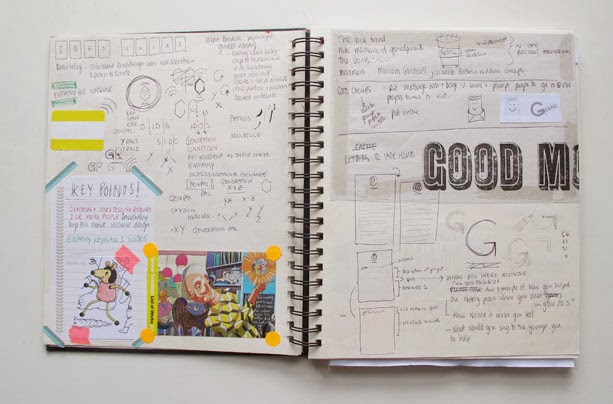
Above - Sketchbook plans on what to create to get our project idea across and how to present it. Initial ideas on presenting all of our research was to print out facebook as one continuous scroll which would hang from the wall and go across the floor. Although an interesting way of looking at how a facebook page translates into print, we did not realise this idea as we thought the audience would not be able to read all of the information on there. To have the research printed on a fold out sheet attached to the wall or wrapped up, or to have it arranged in a timeline across the wall. This would have most likely gone all of the way around the room we were presenting on and so didn't settle on any of these ideas.

100 URBAN TRENDS - SKETCHBOOK RESEARCH/DEVELOPMENT/IDEAS


Whilst researching information to share with the group via our facebook group page I followed the research in my sketchbook trying to link the 3 subjects and find out what they each had in common or trying to find new threads to follow.

I begin to realise a connection between each of the subjects we had chosen where by finding out what makes people happy (the release of oxytocin) we could encourage people to share their stories (storytelling) and then from this find out how to make other people happier (inclusive design) this created a full circle which could be a never ending loop. (see diagram sketch above) We discussed what makes people happy based on personal experience and our research so far. Connections to people, giving, touching, warm temperatures, having meals, being social, sharing stories, balloons. We started to put questions together that we could ask other people outside of our group such as

- What makes you happy?
- How could your day/life be improved?
- What is the most memorable moment in your life?

From this we decided that the main basis of our project would be to go out and find out what makes people happy. From this we would pass the story onto others in the hope it would make them happy or realise that they could perhaps help someone else to be happy in some way by helping them. Rather than like most Inclusive Design products we wanted to create a movement to reach out to the wider audience who perhaps have no knowledge of the issues we were looking at. Hoping through doing this it will encourage more people to be active in the pursuit of happiness.

Empathy - Empathy came up throughout all of my research for the 3 subjects we had chosen. Oxytocin - The brain chemical responsible for empathy, Inclusive Design - Important to understand, share and experience the feelings of another to help them, and Storytelling - Empathy is created through storytelling by learning and understanding more about a particular character for instance.
Ageing population - This was also brought about a lot within the group research and discussion. We began to look at the generations X, Y & Z (see here for more details of the three) Our group are in the the Y generation which is the largest cohort since the baby boomers. This started us questioning what it will be like when we get old and what did we think would make us happy. Comparing this to what makes the older generation happy these days - letter writing, spending time with other people, particularly those in the family of a younger generation. From this we wanted to encourage more young people to take time out and help or spend time with the elderly and to learn from their experiences to help them understand what might make them happier when they are older.

Initial project ideas - From the above we decided to gather stories from our generation about how they have helped an elderly person. To then pass this story on in some way to more of our generation to encourage them to think about these things and perhaps encourage them to do something nice for an elderly person. From our previous research we realised that gift giving or warm temperatures (i.e. warm drinks) released oxytocin. And so our initial idea became about writing these stories or findings onto the hand protectors of the Art School's coffee cups. Alongside the story would be a question put to the person drinking the coffee which they would fill out and drop into a "post box" in the cafe area.

This idea soon developed as we thought more about our previous research, which brought us back to letter writing. With the same concept in mind this brought about our second initial idea which we followed through with.

GENPAL - The idea of GENPAL was to take out a sort of letter/questionnaire that would begin it's journey in an elderly care home. The identity and format of the project was realised and the next day Patti and Steve were ready to spend the day in a care home gathering the information. Once this information was gathered, the next step would be to bring these letters back sealed in an envelope and distribute them among the Art School cafe to the younger generation. They would read the response from the elderly and then respond in return themselves. Once again sealed, these letters would be taken back to the elderly person who wrote that particular letter to read the response made by the younger person.

Below - Logo identity for the GENPAL project. Logo on the right was developed from group discussions. 
Feedback - Logo on right looks too much like a council re-cycling logo, and so does the green colour used.


Our project soon hit a wall when we weren't allowed into any of the homes (despite knowing someone who could get us in!) and so we had to come together as a collective again to re-think where else our project could take us.


Monday, 14 October 2013

100 URBAN TRENDS - COLLABORATION


Last week we were put into mixed groups to work with other peers, each of us studying a different course. My group (Group F) consists of Patti Crozier - Interior Design, Ane Baztarrika - Design Lab, Stephen Starkey - Product Design & Gemma Moran - Fashion. We were introduced to BMW Guggenheim Lab's 100 Urban Trends, from which Annie Shaw had selected 26 of them to pin up to get us started. We were also encouraged to look online at the other 74 and choose 3 of the subjects to work in. After half an hour we were asked to present to the other groups the 3 subjects we had chosen and why. After much discussion our group happily between us had chosen Oxytocin, Storytelling and Slowing Down.

Ane arrived after we had chosen these subjects and so was asked whether she would like to add any to the table that we perhaps had not chosen. Ane asked to include Inclusive Design. I wasn't too sure of this as I didn't feel I could relate to it as much as Slowing Down which we later switched for Ane's choice. One of the first lessons in collaboration - it's a good learning curve to follow someone else's choices sometimes, as they can teach you about it! So now our 3 choices were Oxytocin, Storytelling and Inclusive Design. We chose Oxytocin as it was something that everyone in the group was drawn towards, none of us had heard of the word before but each had a personal understanding or experience with what it is. From this choice we then moved onto storytelling as we thought this would work well with Oxytocin. We spoke about personal objects and the links and stories behind them. Perhaps this was too easy a choice with them being linked quite well? Inclusive Design is something I'd not really looked into before, which is a good thing as I'm learning more about it and how to translate something new into my practise.